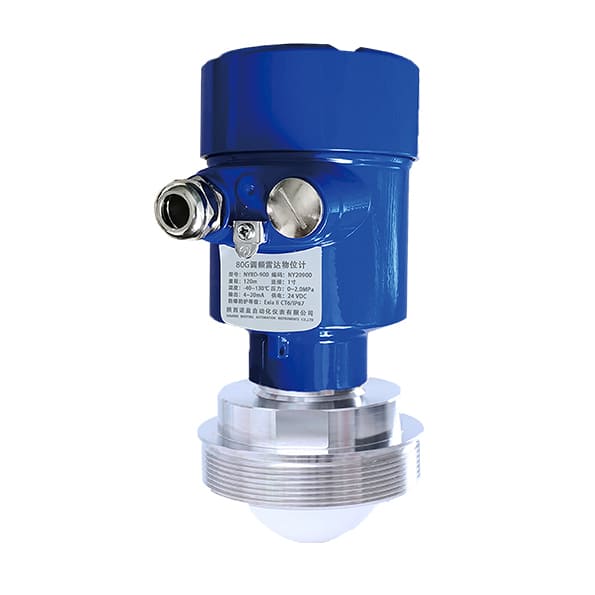
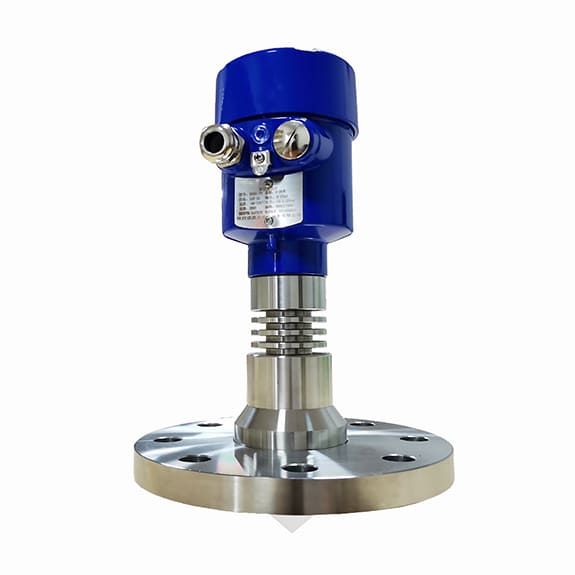
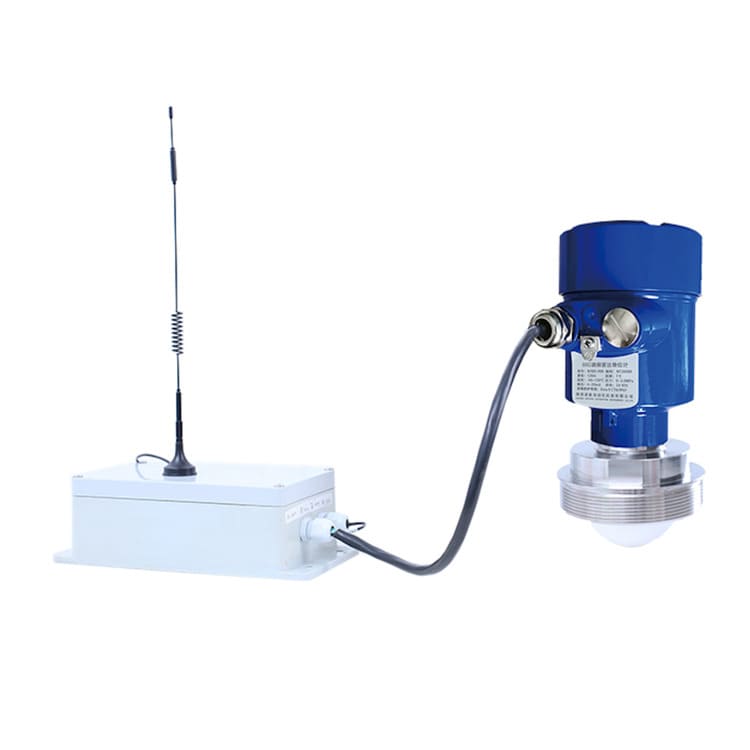
80G Pulse Radar Level Meter
-
80 GHz FMCW Technology
Provides high-resolution signal processing with excellent target separation for precise level detection in liquids and bulk solids. -
Ultra-Narrow 3° Beam Angle
Enables accurate measurement in narrow vessels, tall tanks, and applications with internal obstructions or limited installation space. -
Small 8 cm Blind Zone
Supports high accuracy near the tank top, improving measurement range utilization and inventory precision. -
Long-Range Measurement up to 120 m
Suitable for large silos, deep storage tanks, and long-distance applications where lower-frequency radars struggle. -
Strong Penetration Through Steam and Dust
Maintains stable readings in harsh environments containing vapor, dust, agitation, or process foam. -
High Signal-to-Noise Performance
Millimeter-wave chipset enhances echo reliability, allowing consistent measurement under fluctuating process conditions. -
Wide Temperature and Pressure Compatibility
Designed for challenging process conditions, including high-temperature or high-pressure vessels. -
Maintenance-Free Non-Contact Sensing
Eliminates process interruption and mechanical wear, reducing lifecycle cost and improving operational uptime. -
Flexible Installation Options
Available with threaded, flanged, sanitary clamp, or bracket mounting to match diverse tank designs and process connections.
| Parameter | Specification |
|---|---|
| Product type: | 80 GHz FMCW non-contact radar level gauge |
| Measuring medium: | Liquids and bulk solids |
| Transmitting frequency: | 76–81 GHz |
| Beam angle: | Approx. 3° |
| Measuring range: | 0.08–150 m (typical max range up to 120 m) |
| Blind zone: | Approx. 0.08 m (8 cm) |
| Measurement accuracy: | 0.05–0.1% F.S. |
| Antenna type: | Lens antenna / anti-corrosion lens antenna |
| Antenna material: | PTFE, 304 + PTFE |
| Power supply: | 24 VDC or 220 VAC |
| Signal output; | 4–20 mA / HART / RS485 / Modbus |
| Process temperature: | −40 to +130 °C, −40 to +260 °C (≥260 °C customizable) |
| Process pressure: | −0.1 to +2.0 MPa |
| Process connection: | Thread, bracket, flange, sanitary clamp (optional) |
| Protection class: | IP65, IP67, IP68 (optional) |
| Explosion-proof rating: | Ex ia II CT6 Ga, Ex d II CT6 Gb |
Installation Guide
-
Choose the correct mounting position
Install away from inlet streams, agitators, ladders, or internal structures that may create false echoes. -
Ensure a clear signal path
The radar beam should have an unobstructed view of the medium surface; avoid pointing directly at tank walls or cones. -
Maintain proper alignment
Mount the sensor vertically and align it so the beam is perpendicular to the liquid or solid surface for best accuracy. -
Use appropriate process connections
Select threaded, flange, or clamp connections based on tank pressure, temperature, and sealing requirements. -
Respect minimum distance requirements
Follow the recommended blind-zone clearance (approx. 8 cm) and avoid installation too close to the tank top. -
Stabilize installation on vibrating equipment
Use vibration-resistant brackets or supports when installing on mixers, compressors, or high-vibration vessels. -
Seal all electrical entries properly
Ensure cable glands are tightened and IP protection level is maintained to prevent moisture or dust intrusion. -
Verify power and grounding
Use stable 24 VDC or 220 VAC supply (according to model), and ensure proper grounding to avoid signal interference.
Maintenance Guide
-
Clean the antenna when needed
Remove buildup or deposits on the lens antenna to maintain strong echo quality in steam, dust, or sticky applications. -
Check configuration parameters
Verify tank dimensions, blocking-distance settings, and output configuration after process changes or maintenance work. -
Review echo curves regularly
Use the display or configuration software to confirm stable echo processing and signal quality. -
Inspect sealing and gaskets
Ensure process seals remain intact for high-temperature or high-pressure installations. -
Avoid unnecessary disassembly
Radar is maintenance-free—only perform cleaning or inspections when process conditions require it. -
Revalidate operation after major tank repairs
Confirm measurement accuracy after tank internal changes, new equipment installation, or structure modifications.
-
Large Storage Tanks (Liquids & Solvents)
Accurate long-range level monitoring in vertical tanks, outdoor reservoirs, and process vessels with steam or vapor present. -
Bulk Solid Silos (Powders & Granules)
Stable measurement in tall silos containing cement, grain, plastic pellets, minerals, or aggregates, even with dust generation. -
Chemical Process Vessels
Reliable operation in reactors, mixing vessels, corrosive media tanks, and environments with internal structures or agitation. -
Water & Wastewater Treatment
Continuous level tracking in clarifiers, lift stations, sedimentation basins, and sludge tanks with foam or surface turbulence. -
Oil & Gas Storage and Handling
Precise level detection in crude tanks, refined product storage, separators, and pressurized vessels with varying temperature profiles. -
Power Plant Fuel & Ash Handling
Measurement of coal bunkers, biomass silos, fly ash hoppers, and condensate tanks exposed to high temperature and dust. -
Food & Beverage Process Tanks
Non-contact measurement in hygienic or sanitary vessels containing oils, syrups, dairy ingredients, or CIP fluids. -
Pharmaceutical & Fine Chemical Tanks
High-resolution level monitoring in vessels requiring compact installation, narrow beam control, and stable echo tracking.