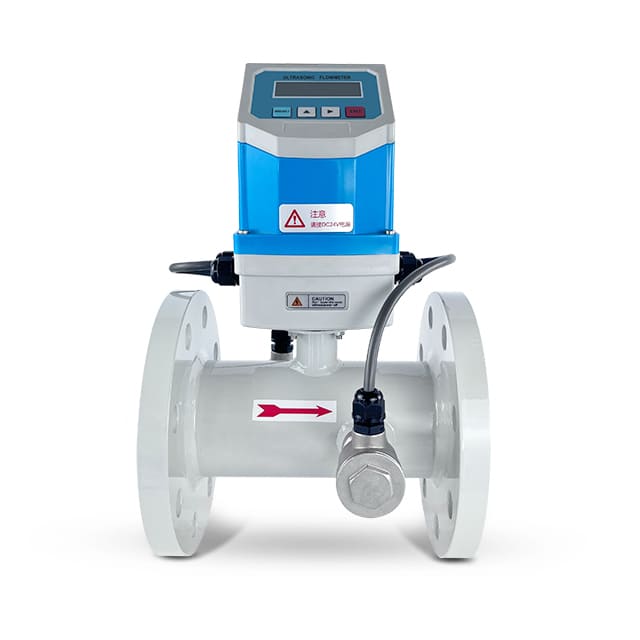
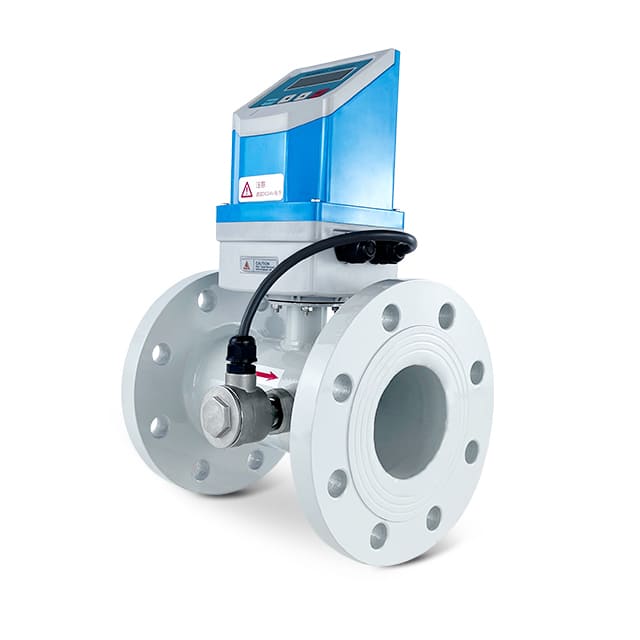
inline Ultrasonic Flowmeter
Approved by:CE, ISO, ATEX Explosion-proof certification
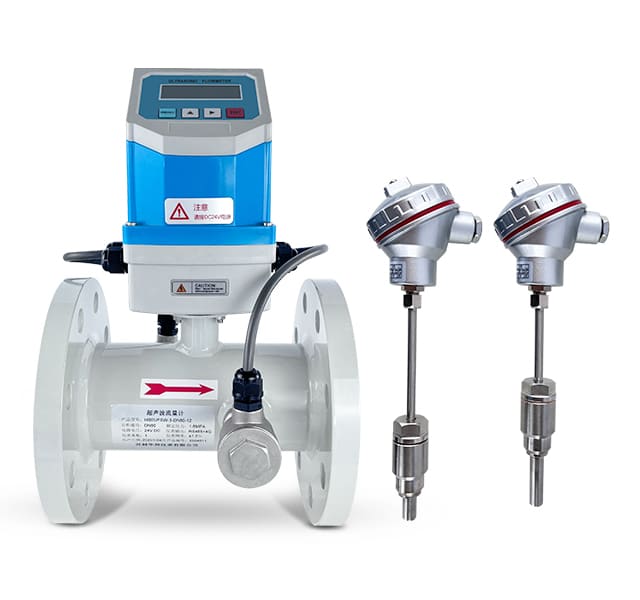
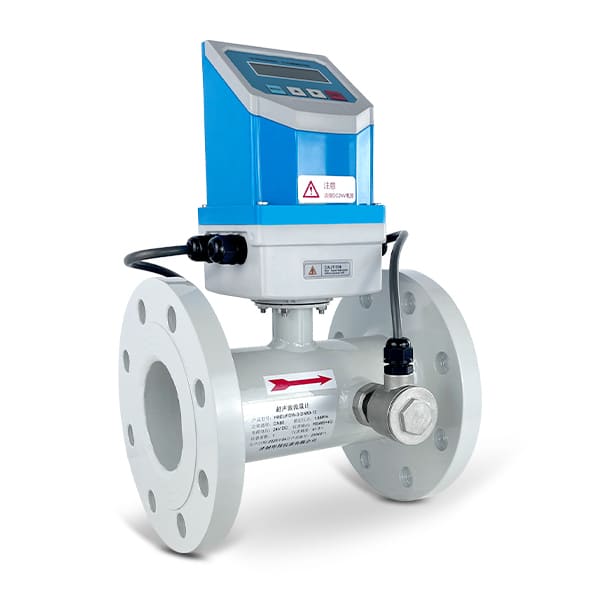
Our inline Ultrasonic Flow Meter is a high-precision, non-intrusive measurement instrument that delivers stable and accurate readings for various conductive and non-conductive liquids. Designed for fixed installations, it uses transit-time ultrasonic technology to measure flow velocity through the pipe wall—without mechanical wear or pressure loss.
With ±1 % accuracy, multi-output integration (4–20 mA, OCT, RS-485 Modbus), and robust data-logging capability, it suits demanding industrial environments across water treatment, chemical, and energy systems. Once installed, it delivers years of reliable, maintenance-free service.
-
High-accuracy ultrasonic sensing: Transit-time technology ensures ±1 % accuracy and 0.2 % repeatability, so you can trust your data for billing, compliance, or efficiency control.
-
Fixed pipe-mount design: Installed permanently on the pipeline, providing long-term reliability without routine recalibration.
-
Multi-output compatibility: Equipped with 4-20 mA, pulse, relay, and RS-485, giving flexible connectivity to PLCs or control systems.
-
Advanced data logging: Automatically records totalizer data of the last 64 days, 64 months, and 5 years, helping operators trace flow history and performance trends.
-
Comprehensive display: LCD with backlight shows flow rate, total flow, heat rate, temperature, and more—making diagnostics straightforward on site.
-
Bi-directional measurement: Measures both forward and reverse flow for applications requiring net or differential flow tracking.
-
Supports multiple pipe and liquid types: Handles pipe diameters from DN 15 to DN 6000 mm and materials such as steel, PVC, copper, or FRP—suitable for almost all industrial liquids.
-
Durable, low-power design: Consumes less than 1.5 W and runs stably in harsh industrial environments from -30 °C to 80 °C.
-
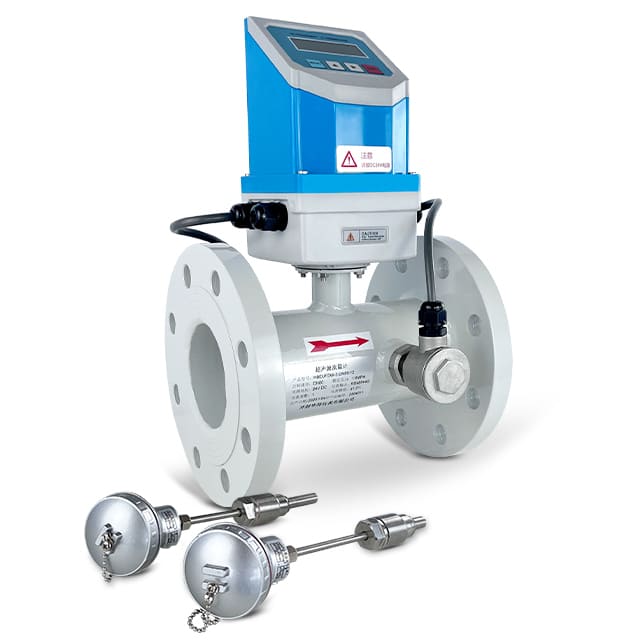
Optional temperature inputs: Connect PT100 sensors to calculate energy/heat flow, ideal for HVAC or thermal energy systems.
-
Self-diagnostic and alarms: Monitors signal strength, quality, and error codes automatically, reducing downtime through early alerts.
- Nominal diameter: DN 10 – 600 mm
- Accuracy: <±1 %
- Repeatability: 0.2 %
- Medium flow velocity: 0.5 ~ 15 m/s
- Measurement period: 500 ms
- Pressure Range: 0.6 ~ 4.0MPa
- Digital communication: RS-485 (Modbus, M-Bus, Fuji protocols)
- Data recording: Stores totalizer data for 64 days, 64 months, and 5 years
- Power supply: DC 24 V
- Power consumption: < 1.5 W
- Pipe materials supported: Steel, stainless steel, cast iron, copper, PVC, aluminum, FRP (with liners allowed)
- Liquid types; Water, sea water, industrial sewage, acids / alkalis, alcohol, beer, oil, and other ultrasonic-conductive liquids |
- Liquid temperature: Standard −30 °C – +90 °C; high-temperature −30 °C – +160 °C
- Environmental temperature: Main unit −30 °C – +80 °C; transducer −40 °C – +110 °C
- Humidity / Protection: 85 % RH; transducer water-immersible (up to 3 m)
- Cable length: Standard 20 m (twisted pair); extendable to 500 m (consult factory)
- Protocols supported: Modbus, M-Bus, Fuji Extended, and factory protocols
Installation tips
-
Mount transducers on a clean, straight section of full pipe; avoid air pockets and heavy deposits.
-
Follow the straight-run rule: at least 10× pipe diameter upstream and 5× downstream (minimum 30 × D from pumps).
-
Choose appropriate transducer types and installation methods (V, Z, W, N) according to pipe diameter and space.
-
Apply couplant evenly and ensure firm contact between sensor and pipe wall.
-
Verify signal strength (50–99) and quality (5–9) on display before commissioning.
Operational care
-
Avoid strong vibration or electrical noise sources.
-
Use specified DC 24 V power supply with proper grounding.
-
Do not open the main unit in humid conditions; use dry cloth for cleaning.
-
For re-calibration, use reference flow standards or factory service.
-
Periodically check transducer coupling and clean surfaces if scale build-up occurs.
-
Water & Wastewater Treatment Plants – Continuous monitoring of raw water, filtered water, and discharge pipelines.
-
Power & Energy Systems – Condensate, feedwater, and cooling-water flow measurement; thermal energy (heat/cold) metering.
-
Chemical & Petrochemical Plants – Flow monitoring of acids, solvents, oils, and other process liquids.
-
Food & Beverage Production – Non-intrusive measurement for hygienic pipelines carrying beverages, alcohol, or liquid food.
-
Building & HVAC Management – Energy-balance and chilled/hot-water flow measurement for heating and cooling systems.
-
Industrial Sewage & Recycling – Accurate metering in pipes carrying industrial wastewater or reclaimed fluids.